Introduction
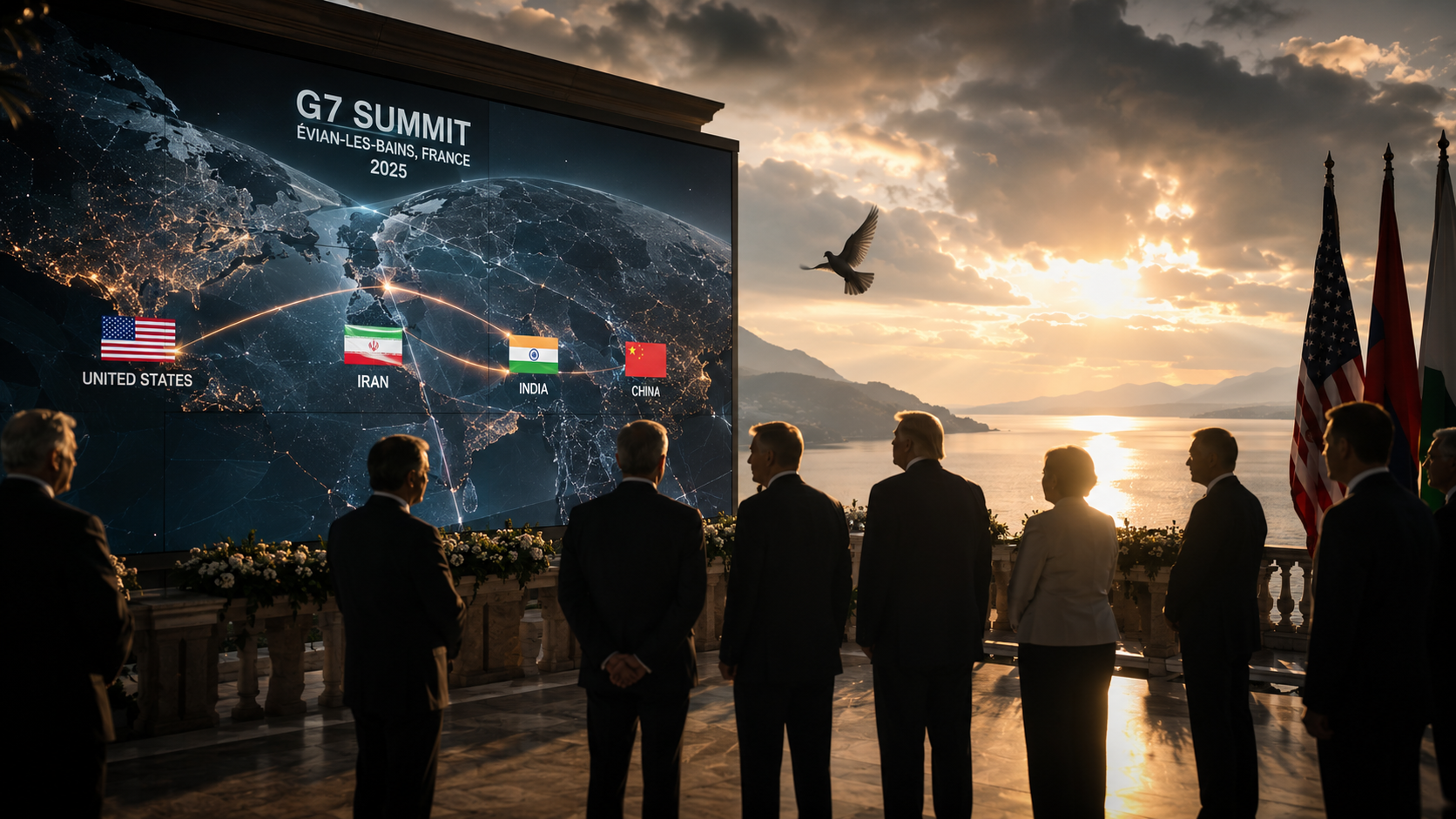
In a moment that few analysts predicted just months ago, the United States and Iran have reached a preliminary peace agreement that could fundamentally reshape the Middle East — and the global balance of power itself. The deal, which is the centerpiece of this week’s G7 summit in Évian-les-Bains, France, includes an end to all hostilities in the region, the restoration of free navigation through the strategic Strait of Hormuz, and, in a stunning development, a provision for Israel’s withdrawal from Lebanon.
But if you think this is just another Middle East peace process, think again. Canadian Prime Minister Mark Carney, speaking on the sidelines of the summit today, delivered a blunt assessment that sent shockwaves through diplomatic circles: “The G7 no longer runs the world.” His words were not a complaint but a recognition of a geopolitical reality that has been building for years. The US-Iran deal, whatever its merits or flaws, is being negotiated in a world where Washington can no longer dictate terms, Beijing watches with growing influence, and New Delhi is quietly asserting itself as a power broker.
As oil prices tumble in response to the prospect of peace and diplomatic cables buzz with speculation about the deal’s finer points, one question dominates: is this the dawn of a new, more stable Middle East order — or a fragile mirage that will dissolve as quickly as it appeared?
The Anatomy of the Deal – What We Know So Far
According to multiple sources briefed on the negotiations, the preliminary agreement contains several landmark provisions that go far beyond the nuclear constraints of the 2015 Joint Comprehensive Plan of Action (JCPOA).
Key Provisions
The first and most immediate element is the cessation of all hostilities across the Middle East. This includes a formal end to the proxy conflicts that have defined the region for decades, from Yemen to Syria to Iraq. The Houthi rebels in Yemen, long backed by Iran, have reportedly agreed to a ceasefire and political negotiations with the Saudi-led coalition. In Syria, Iranian military advisors are expected to withdraw, though the timeline remains murky.
Second, and perhaps most consequential for global energy markets, is the restoration of free navigation through the Strait of Hormuz. Iran has agreed to cease harassment of commercial shipping and allow unhindered passage for all vessels. The strait, through which approximately 20% of the world’s oil supply passes, has been a flashpoint for years. Tanker attacks, seizures, and military posturing have added a persistent risk premium to oil prices. Within hours of the announcement, Brent crude dropped nearly 8%, briefly falling below $65 a barrel before stabilizing.
Third, and the most controversial element, is the provision for Israel’s withdrawal from Lebanon. While details remain scarce, the framework reportedly includes a phased Israeli military pullback from southern Lebanon, coupled with a strengthened UN peacekeeping presence along the border. In exchange, Hezbollah, the Iranian-backed militant group that effectively controls southern Lebanon, has agreed to disarm and transform into a purely political organization. Israeli Prime Minister Naftali Bennett, who is attending the G7 summit, has neither confirmed nor denied the reports, stating only that “Israel will do what is necessary to protect its citizens.”
What’s Missing
Notably absent from the preliminary agreement is any specific mention of Iran’s nuclear program beyond a vague commitment to “continued compliance” with the NPT. This omission has alarmed some analysts, who worry that the current administration in Washington has prioritized immediate de-escalation over long-term non-proliferation goals. As one former State Department official told The Wall Street Journal: “We are trading a potential nuclear breakout in a decade for a ceasefire today. That’s a bet, not a strategy.”
The G7 Summit – A Venue for a Changing World
The choice of Évian-les-Bains as the summit location is itself symbolic. The picturesque French town on the shores of Lake Geneva has long been a venue for high-stakes diplomacy, but this year’s gathering feels different. The mood is less about coordinating Western policy and more about acknowledging Western decline.
Mark Carney’s declaration that the G7 “no longer runs the world” was not an isolated comment. It reflects a growing recognition among Western leaders that the old order — dominated by the US, Europe, and Japan — has been superseded by a more complex, multipolar system. India, Brazil, South Africa, and Indonesia are no longer just emerging markets; they are power centers with their own interests and alliances.
India’s presence at the summit, even as a guest nation, is telling. Prime Minister Narendra Modi has been courted by both Washington and Beijing, and his government has skillfully maintained strategic autonomy while deepening economic ties with the West. As we explored in our recent analysis of India’s sovereign AI push, New Delhi is increasingly comfortable asserting its own vision of global order — one that does not automatically defer to Washington or Beijing.
The Economic Stakes
For global businesses and investors, the peace deal carries both promise and peril. The immediate market reaction — falling oil prices, rising European stocks, and a weakening dollar — suggests optimism about reduced geopolitical risk. But beneath the surface, the deal exposes deeper vulnerabilities.
European economies, still recovering from the energy shocks of 2022 and 2023, stand to benefit most from stable Middle East oil flows and a potential reopening of Iranian gas pipelines to Europe. Germany, in particular, has been quietly lobbying for a deal that could ease its energy dependence on Russia and the US. French President Emmanuel Macron has positioned himself as a mediator, eager to restore France’s traditional role in Middle East diplomacy.
American businesses, however, face a more complex calculus. The deal could open the door for US companies to re-enter the Iranian market, which has been largely off-limits since the re-imposition of sanctions in 2018. Energy, automotive, and technology sectors are already exploring opportunities, though the reputational and legal risks remain significant. Meanwhile, Chinese firms, which have maintained a presence in Iran throughout the sanctions period, are well-positioned to benefit from any economic opening, raising concerns in Washington about a potential loss of competitive advantage.
The Geopolitical Chessboard – Who Really Wins?
China’s Quiet Advantage
Beijing has watched the US-Iran negotiations with a mixture of relief and satisfaction. Relief, because a wider Middle East war would destabilize oil markets and threaten China’s energy imports, which are heavily dependent on the Strait of Hormuz. Satisfaction, because the deal, whatever its merits, represents a tacit acknowledgment that Washington cannot resolve global conflicts alone.
China’s Belt and Road Initiative (BRI) has already invested billions in Iranian infrastructure, including ports, railways, and telecommunications. A stable Iran, integrated into the global economy, would provide China with a reliable land and sea corridor to Europe and the Middle East. Beijing is reportedly in advanced discussions with Tehran about a 25-year strategic partnership that would deepen economic and military ties, potentially including a naval base in the Gulf of Oman.
India’s Balancing Act
For India, the US-Iran deal is a diplomatic win that requires careful navigation. New Delhi has maintained close ties with Tehran — Iranian oil was a major source of Indian imports before US sanctions — while also cultivating a strategic partnership with Israel and the United States. A peace deal allows India to pursue its economic interests in Iran without antagonizing Washington or Tel Aviv.
Indian Foreign Minister S. Jaishankar, who is attending the G7 summit as a special envoy, has reportedly been involved in back-channel negotiations, offering India’s diplomatic and logistical support for the implementation of the deal. This is a classic example of India’s multi-alignment strategy, which seeks to maximize influence by avoiding rigid alliances. For New Delhi, the deal is not just about the Middle East; it is a validation of India’s growing status as a power that can shape global outcomes.
Russia’s Diminishing Role
The deal is also a reflection of Russia’s diminished influence in the Middle East. Moscow, which has been bogged down in Ukraine and distracted by internal political turmoil, has been largely sidelined from the negotiations. While Russia maintains a naval base in Syria and close ties with Iran, its capacity to mediate or project power has been significantly reduced. This has created a vacuum that the US and Europe have filled, albeit reluctantly.
Some Russian analysts have expressed concern that a US-Iran detente could threaten Moscow’s strategic position in the region. A stable, US-aligned Middle East would reduce Russia’s leverage over energy markets and limit its ability to use the region as a foil against Western interests. However, the Kremlin has publicly welcomed the deal, framing it as a positive development that could reduce global tensions.
The Fragility Factor – Why This Deal Could Still Collapse
Despite the optimism, the deal’s fragility is impossible to ignore. The preliminary agreement is precisely that — preliminary. The actual implementation requires buy-in from a host of actors who were not at the negotiating table, including the Houthis, Hezbollah, Syrian President Bashar al-Assad, and various Iraqi militias.
Domestic Opposition
In Iran, the deal is deeply controversial. The conservative clergy and the Islamic Revolutionary Guard Corps (IRGC) have expressed skepticism about any agreement that involves concessions on Iran’s regional influence. Supreme Leader Ali Khamenei, who has the final say on all matters of state, has not yet publicly endorsed the agreement. His silence is deafening, and it suggests that the hardliners are not fully on board.
In Israel, the deal is viewed with profound suspicion. Prime Minister Bennett’s government is facing intense pressure from right-wing coalition partners to reject any agreement that involves territorial withdrawals or compromises with Hezbollah. Bennett’s statement that “Israel will do what is necessary” is a carefully calibrated message that leaves the door open for unilateral action if the deal is seen as threatening Israeli security.
The Implementation Gap
Even if all parties sign, the implementation challenges are monumental. The disarmament of Hezbollah, for example, would require a level of trust and verification that is almost impossible to achieve in a region defined by decades of conflict. UN peacekeepers, already stretched thin, would need significant reinforcements to patrol Lebanon’s southern border effectively.
Similarly, the cessation of hostilities in Syria and Yemen involves a bewildering array of armed groups, many of which operate independently of their nominal leaders. The Houthi-Houthi internal divisions alone could undermine any ceasefire agreement.
The American Question
Finally, there is the American question. The current administration has staked significant political capital on this deal, but the 2026 midterm elections are just months away. If the opposition party gains control of Congress, the deal’s funding and implementation could be stalled. More fundamentally, the American public, tired of Middle East entanglements, may not have the appetite for the extended military and financial commitments that a stable peace would require.
Conclusion
The US-Iran peace deal, for all its uncertainties, is a landmark moment in international diplomacy. It reflects a recognition that the old order — where a handful of Western powers could shape global outcomes — is no longer viable. The presence of India at the G7 summit, the quiet influence of China, and the pragmatic engagement of European leaders all point to a world that is more complex, more multipolar, and more unpredictable.
Will this deal hold? The optimist sees a future of reduced conflict, stable energy markets, and a Middle East that is finally turning a corner. The pessimist sees a fragile agreement that will be tested by spoilers, domestic opposition, and the relentless logic of regional rivalries.
The truth, as always, lies somewhere in between. But one thing is certain: the era of Western-dominated geopolitics is over. The question is not whether a new order will emerge, but who will shape it — and whether it will be more stable than the one it replaces.
As Mark Carney noted, the G7 no longer runs the world. The world is now run by a complex web of powers, interests, and alliances. Whether we like it or not, that is the new reality — and the US-Iran deal is its clearest expression yet.
What do you think about the US-Iran peace deal? Is it a genuine breakthrough or a diplomatic illusion? Do you believe the G7’s influence is truly waning, or is this just a temporary shift? Share your thoughts in the comments below.