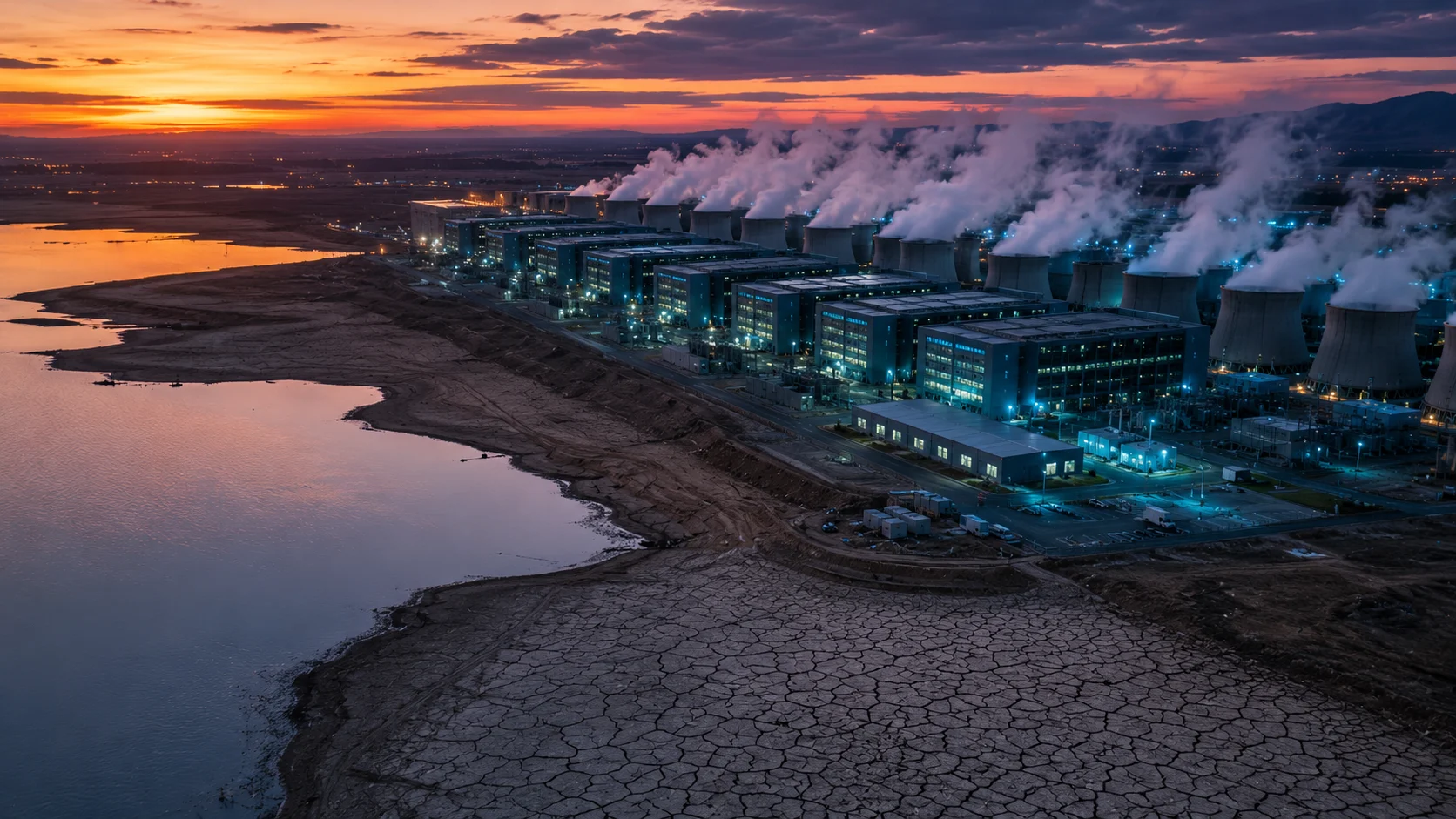
AI data center water crisis
Introduction
AI data center water crisis. Here’s a number that should stop you mid-scroll: training and running a single large AI model can consume millions of liters of fresh water, not for drinking, but for cooling the servers that make your chatbot respond in half a second. For years, the conversation around AI’s physical limits centered on chips and electricity. Nvidia couldn’t make GPUs fast enough. Power grids couldn’t keep up with demand. Those stories made headlines because they were easy to visualize, a chip shortage, a blackout, a billion-dollar funding round.
But a quieter, thirstier problem has been building underneath all of it. In June 2026, SpaceX added a line to an amendment of its IPO filing that caught far less attention than it deserved, warning investors that water access, not just electricity, is becoming a critical constraint on operating and expanding large-scale AI infrastructure. When a company built on rockets and satellites starts worrying publicly about water, it’s worth asking what everyone else already knows and hasn’t said out loud.
This is the resource crisis nobody priced into the AI boom. And it’s arriving faster than most companies, or most cities, are prepared for.
Why AI Data Centers Are So Thirsty
Modern AI training runs generate enormous amounts of heat. A single rack of GPUs working on a large language model can produce as much thermal output as a small office building, packed into a few square feet. Air cooling alone can’t handle that load efficiently at scale, so most hyperscale facilities rely on evaporative cooling systems, the same basic principle as a swamp cooler, just industrialized to a staggering degree.
Evaporative cooling works by allowing water to evaporate, which pulls heat out of the system. It’s efficient and relatively cheap. It’s also consumptive in the strictest sense: the water doesn’t come back. It evaporates into the atmosphere and leaves the local watershed entirely.
The Numbers Behind the Headlines
According to research cited by MIT Technology Review, a midsize AI data center can use between one and five million gallons of water per day, comparable to the daily water consumption of a town of 10,000 to 50,000 people. Multiply that across the hundreds of new facilities currently planned or under construction across the United States, and the scale becomes difficult to overstate.
This isn’t theoretical anymore. As we covered in our previous article on the data center buildout slowdown, analysts now estimate that 30 to 50 percent of roughly 140 planned U.S. data centers, representing 16 gigawatts of capacity, may miss their 2026 timelines or be cancelled outright. Power bottlenecks get most of the blame. But in a growing number of cases, water access and local opposition tied to it are just as decisive.
The Communities Pushing Back
In Ohio, residents recently pushed a ballot measure that could ban hyperscale data centers statewide, after the state suspended a major tax incentive when projected exemption costs surged. The objection wasn’t only about jobs or tax breaks. It was about who pays when a single facility’s water draw starts competing with a town’s drinking supply, farmland irrigation, or already-stressed regional aquifers.
Similar tensions are surfacing well beyond Ohio. Drought-prone regions in the American Southwest, where several major cloud providers have built or proposed new campuses, are facing the same uncomfortable math: AI infrastructure and agriculture are now drawing from the same shrinking pool, in places where that pool was already shrinking before AI entered the picture.
According to reporting from the Wall Street Journal, several municipalities have begun requiring water-usage disclosures as a condition of approving new data center permits, a level of scrutiny that simply didn’t exist three years ago. Quietly, water is becoming the new zoning fight.
It’s Not Just an American Problem
Europe’s sovereignty-driven AI buildout faces its own version of this constraint, particularly in southern regions already grappling with drought cycles intensified by climate change. Spain and Portugal, both courting AI infrastructure investment as part of broader digital sovereignty pushes, are doing so while managing some of the continent’s most acute water stress. The tension between economic ambition and environmental reality isn’t unique to any one country. It’s structural to how AI infrastructure gets built right now.
What the Industry Is (and Isn’t) Doing About It
To be fair, this isn’t an industry that’s ignoring the problem entirely. Several hyperscalers have committed to “water positive” pledges, promising to replenish more water than their operations consume by 2030, often through watershed restoration projects or efficiency investments elsewhere. Microsoft, Google, and Meta have all made versions of this commitment publicly.
The harder question is whether those pledges can scale at the pace AI infrastructure itself is scaling. Closed-loop liquid cooling systems, which recirculate coolant instead of letting it evaporate, are gaining traction and can cut water consumption dramatically. But retrofitting existing facilities is expensive, and many of the newest mega-campuses are still being designed around the cheaper, thirstier evaporative model because speed to market currently matters more than long-term resource efficiency.
There’s also a geographic mismatch worth noting. Some of the most attractive locations for data centers, places with cheap land, available power, and tax incentives, are not the places with abundant fresh water. That mismatch doesn’t resolve itself with a corporate pledge. It requires actual engineering trade-offs, and those trade-offs cost time and money that the current AI investment race doesn’t always reward.
As Forbes noted in coverage of the broader AI infrastructure spending surge, hyperscaler capital expenditure has now crossed $700 billion for 2026 alone. Against that backdrop, water efficiency upgrades that might cost tens of millions of dollars per facility can look like a rounding error, or like the next obvious place to cut corners under competitive pressure.
Why This Matters Even If You’ll Never Visit a Data Center
It’s tempting to treat this as someone else’s problem, an issue for utility regulators and small-town planning boards. But the water-AI collision touches anyone living near a planned facility, anyone whose local agriculture competes for the same aquifer, and arguably anyone who cares whether the AI tools reshaping daily life are being built sustainably or simply fast.
There’s also a market dimension that investors are starting to price in. If water access becomes a genuine bottleneck on AI infrastructure expansion, the way power bottlenecks already have, it could slow the pace of compute growth that’s currently baked into valuations across the AI sector. SpaceX flagging this risk in IPO documents isn’t just due diligence theater. It’s a signal that sophisticated investors are starting to treat water the way they’ve treated chip supply for the past two years: as a constraint that can move markets.
As we discussed in our earlier piece on the AI infrastructure capital race, the winners of this next phase may not be the companies with the smartest models. They may be the ones that figure out how to build compute capacity without running headlong into the physical limits of the planet it sits on.
Conclusion
The AI industry has spent two years racing to solve its chip problem and its power problem, throwing unprecedented capital at both. Water is shaping up to be the constraint that catches everyone slightly off guard, not because the data wasn’t available, but because it was easier to look away from a slower-moving crisis while the more dramatic ones grabbed headlines.
That’s changing now. Drought-stricken communities are organizing. Investors are asking questions. And companies that once treated water access as an afterthought are starting to put it in their risk disclosures. The next chapter of the AI boom may be decided less by who has the best model, and more by who can keep the lights, and the cooling systems, running without draining the towns around them dry.
Do you think water scarcity will slow down AI infrastructure growth, or will the industry engineer its way around the problem in time? Share your thoughts in the comments below. —
What do you think about this trend? Share your thoughts in the comments below.
Also Read: EU AI Act Fines Hit Big Tech Hard: A Game-Changer for AI Regulation
About The Author